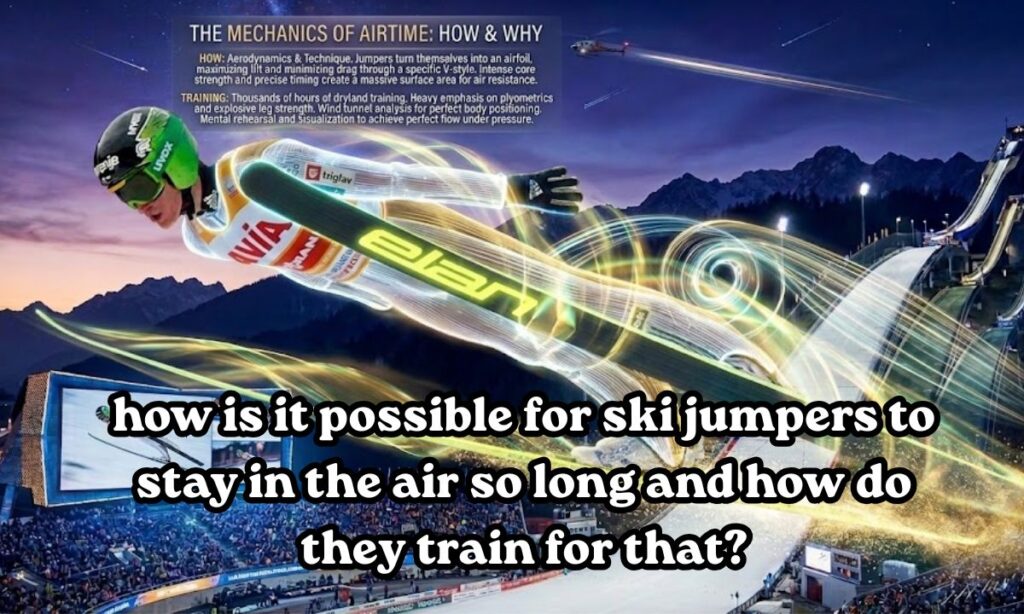
The physics of aerodynamic lift, the biomechanics of human flight, and the decade-long training journey that turns athletes into airborne athletes — all explained in full detail.
Few spectacles in winter sport are as hypnotic as watching a ski jumper leave the ramp and glide, seemingly without effort, through open air for the length of a football field. Every spectator watching for the first time asks the same question: how is it possible for ski jumpers to stay in the air so long and how do they train for that? The answer draws from aerodynamics, Newtonian physics, biomechanics, sports science, and an extraordinary commitment to athletic mastery that begins in childhood and never truly ends.
This guide breaks down every component of the phenomenon — from the forces at work the instant a jumper’s boots leave the takeoff table, to the wind tunnel sessions, summer ramp repetitions, plyometric programs, and mental conditioning regimens that allow elite athletes to spend six or seven breathtaking seconds suspended between earth and sky.
The Physics Behind Ski Jumping Flight: Why Gravity Loses
To understand why ski jumpers stay airborne for so much longer than a basketball player or a long jumper, you need to understand three forces that govern every second of the flight: lift, drag, and gravity.
Gravity: The Constant Opponent
Gravity acts on every object equally. There is nothing a ski jumper — or any athlete — can do to reduce its pull. What they can do is generate counteracting forces powerful enough to slow their rate of descent dramatically, and that is precisely what the best jumpers in the world have mastered. A jumper in optimal aerodynamic position may descend at only 2–3 meters per second vertically, while traveling at 25 or more meters per second horizontally. The result is that forward distance accumulates rapidly while vertical drop stays relatively small.
Lift: The Upward Force That Defines the Sport
Lift is the upward force generated when moving air interacts with a surface positioned at the correct angle. It is the same principle that allows airplane wings to hold hundreds of tonnes of aircraft in the sky. Ski jumpers generate aerodynamic lift by positioning their bodies at a precise angle to oncoming airflow — essentially turning their torso, arms, and skis into a large, flat wing.
When a jumper leans their entire body nearly parallel to the ground and spreads their skis into the distinctive V-shape that has defined the sport since the late 1980s, they create an enormous surface area. As air strikes this surface, it is deflected downward. Newton’s Third Law of Motion states that for every action there is an equal and opposite reaction — and so the air pushes the jumper upward with the same force with which the jumper deflects the air downward. That upward push is lift, and it is the direct answer to why ski jumpers stay airborne for durations that dwarf what any ordinary vertical jump could achieve.
A standard vertical jump — even by a world-class athlete — keeps a person airborne for less than one second. Ski jumpers routinely achieve five to seven seconds of flight, with elite competitors on large hills and ski flying venues sometimes exceeding eight seconds. The difference is entirely explained by aerodynamic lift.
Drag: The Force That Must Be Managed, Not Eliminated
Drag is air resistance — the friction created by an object moving through air. Drag opposes forward motion and, as it slows the jumper down, it also reduces lift, since lift depends on airspeed. The goal of every ski jumper is not to eliminate drag entirely (which would be physically impossible) but to manage it strategically. During the in-run phase, minimizing drag is the absolute priority. During flight, the goal shifts to generating maximum lift while keeping drag at an acceptable level — the lift-to-drag ratio becoming the defining metric of aerodynamic quality.
This tension between generating enough surface area to produce lift and keeping the body streamlined enough to prevent excessive drag is what makes ski jumping technique so technically demanding. A jumper cannot simply make themselves as large as possible; they must find the exact body position that optimizes the lift-to-drag ratio for the specific speed and hill profile they are working with.
The Four Phases of a Ski Jump: A Technical Breakdown
Understanding how ski jumpers stay in the air requires looking at the full sequence of a jump, because each phase feeds directly into the next.
Phase 1: The In-Run (Approach Phase)
A ski jump begins at the top of an in-run, a steeply inclined ramp that angles downward at approximately 35 degrees. Here, the jumper crouches into a tightly aerodynamic position — knees bent, body leaned forward, arms pressed close to the body, chin tucked. Every centimeter of unnecessary body exposure to the wind creates drag that bleeds away speed.
Speed is everything at this stage. By the time the jumper reaches the end of the ramp, they are typically traveling at 85 to 95 kilometers per hour (roughly 55–60 miles per hour). This kinetic energy, built by the conversion of gravitational potential energy into speed as they descend the ramp, is the raw fuel for the entire flight. A slower approach speed means less lift generated in the air, which means a shorter jump. Elite jumpers invest enormous effort in perfecting their in-run crouch so that they arrive at the takeoff point with maximum velocity and minimum energy lost to friction or drag.
Computational fluid dynamics research published in peer-reviewed journals has confirmed that torso angle during the in-run is the single most influential factor in drag reduction at this stage. Marginal adjustments — sometimes as small as two degrees — can reduce cumulative air resistance by measurable percentages and meaningfully change the jump outcome.
Phase 2: The Takeoff
The takeoff is the most technically critical and brutally brief moment in the entire jump. At the end of the ramp — which angles slightly downward at approximately 10 degrees — the jumper must explosively extend their legs while simultaneously transitioning their body from the crouched in-run position to the flat, forward-leaning flight position. The entire window for this movement is roughly 0.25 to 0.30 seconds.
This explosive leg extension requires extraordinary single-leg power. The jumper is essentially performing a maximal effort jump at nearly 90 kilometers per hour, under conditions of intense aerodynamic pressure, while simultaneously executing a complex body movement that will determine the angle and shape of their flight trajectory. Even a few degrees of error in the takeoff angle — too high or too low — can cost ten meters or more of distance.
The transition from in-run position to flight position must be fluid and instantaneous. Timing that falls outside the optimal window wastes the kinetic energy built on the ramp, reduces the effectiveness of the aerodynamic lift generated once airborne, and can destabilize the jump entirely. Elite athletes dedicate thousands of repetitions to making this transition automatic — a reflex rather than a conscious decision.
Phase 3: The Flight Phase
This is where the magic happens — and where the physics becomes truly fascinating. Once in the air, the ski jumper spreads their skis into the V-shape and leans their torso forward until it is nearly parallel to their skis. The arms are pressed tight against the body, the chin is tucked down, the hands hover close to the thighs.
In this position, the jumper has become — in the most literal biomechanical sense — a wing. The skis function as the primary lift-generating surface, while the body and suit contribute additional lift area. Air flows over this composite surface and generates the upward force that dramatically slows the rate of descent, allowing the jumper to travel enormous horizontal distances while gravity pulls them toward the landing slope below.
The V-style position, now universal among elite competitors, is credited with increasing aerodynamic lift by approximately 28–30% compared to the old parallel ski technique that dominated the sport until the late 1980s. Research using wind tunnel experiments and computational fluid dynamics simulations has established that the optimal V-angle — the spread between the two ski tips — is approximately 22 to 30 degrees, depending on the jumper’s body proportions, the hill profile, and current wind conditions. The ideal ankle angle that keeps the skis flat against the airflow direction has also been studied in biomechanical detail, with findings showing that even changes of 20 degrees at the ankle joint produce significant improvements in the lift-to-drag ratio.
During flight, the jumper is not passive. Subtle adjustments of the arms, hands, and hip position allow fine-tuning of the flight trajectory. Extending the arms slightly forward or adopting a specific palm orientation changes the lift coefficient. Micro-adjustments to the hip angle shift the center of gravity and influence pitching stability. The best jumpers in the world read the air in real time and make continuous micro-corrections throughout the six or seven seconds they spend airborne.
Phase 4: The Landing
The landing phase requires its own mastery. Jumpers must transition from the V-flight position to the Telemark landing position — skis parallel, one ski placed slightly forward, no more than two ski widths between them — while simultaneously managing the aerodynamic and gravitational forces still acting on them at significant speed.
The design of the landing hill is a crucial enabler of safe landings. The slope is specifically engineered so that it curves away from horizontal at approximately the same rate as the jumper’s natural descent trajectory. This means that at the moment of landing, the jumper is never more than roughly ten to fifteen feet above the actual slope surface. The vertical drop at touchdown — despite covering over 100 meters of horizontal distance — is comparable to jumping off a medium-height table. The slope absorbs the downward component of velocity, while forward momentum continues naturally.

The V-Style Revolution: A Technique That Changed Everything
Before 1988, ski jumpers used the traditional parallel technique — skis pressed together and pointed forward, with the body upright. Then a Swedish jumper named Jan Boklöv began experimenting with spreading his ski tips apart in a V configuration. The aerodynamic advantage was immediately apparent: the wider surface area generated significantly more lift, and distances increased dramatically.
Within a decade, the V-style was universal. Today it is the only technique used in competitive ski jumping worldwide. The parallel style is essentially extinct at the elite level because the aerodynamic difference is too large to overcome with any other advantage. The V-style increased average competitive distances by 10–15% when it was first widely adopted — a staggering improvement in a sport where centimeters matter enormously for scoring.
The technique continues to be refined. Biomechanical research has investigated the interaction between V-angle, body lean angle, ankle position, arm placement, and head angle in remarkable detail. CFD simulations have allowed researchers to model the airflow around the jumper/ski system and identify optimal configurations for specific conditions. Wind tunnel testing has allowed coaches and athletes to translate these findings into real-world improvements, millimeter by millimeter.
Equipment: The Technology That Maximizes Aerodynamic Performance
The jumper’s body and technique are only part of the aerodynamic equation. Equipment plays a significant role, though it is tightly regulated by the Fédération Internationale de Ski (FIS) to ensure that athletic technique — not equipment superiority — determines results.
Skis: Surface Area as a Weapon
Ski jumping skis are dramatically different from alpine or cross-country skis. They are longer, wider, and specifically designed to function as aerodynamic lifting surfaces. FIS regulations allow skis to be a maximum of 145% of the jumper’s height in centimeters, and they are 1.5 times wider than standard alpine skis.
The length rule creates an interesting dynamic: taller jumpers receive proportionally longer skis, giving them more lift surface area. However, there is a BMI (Body Mass Index) rule that adjusts the maximum permitted ski length for athletes below a BMI of 21. This regulation was introduced specifically to combat dangerous weight loss that was occurring as athletes sought to qualify for the maximum ski length. Lighter jumpers stay airborne more easily (less weight for the same lift force), but the BMI rule prevents this advantage from incentivizing harmful behavior.
Ski design has also evolved to optimize aerodynamic interaction with the V-position. Around 2010, curved binding sticks were introduced at the rear of the ski bindings to help jumpers keep their skis flatter relative to the direction of motion — improving the aerodynamic efficiency of the ski/jumper system as a whole. alhambra palace night tour attendance revenue
Suits: Regulated Surface, Controlled Permeability
Ski jumping suits are made from spongy microfiber material with carefully controlled air permeability. They must fit within two centimeters of the body at any point — close enough to prevent the suit from acting as a parachute or “squirrel suit” that generates unregulated additional lift, but designed with enough give to allow the necessary aerodynamic body positioning.
FIS inspectors measure suits before every competition. Athletes who fail the inspection — either because suits are too loose or constructed from non-compliant materials — are disqualified. This happened visibly at the 2022 Beijing Winter Olympics, where five female ski jumpers were disqualified for suit violations. The incident demonstrated how aggressively equipment regulations are enforced and how significant even minor suit variations can be to aerodynamic performance.
The Training System: Building a Human Airfoil Over a Decade
How is it possible for ski jumpers to stay in the air so long and how do they train for that? The training answer is as fascinating as the physics. Elite ski jumping training is year-round, highly specialized, and typically begins in childhood. Most national-level programs see athletes start on small “springboard” hills before age ten and spend the next decade progressively building toward the large hills of Olympic and World Cup competition.
The training system encompasses six major pillars: wind tunnel work, summer ramp training, physical conditioning, video analysis, mental preparation, and progressive jumping. Each is critical, and none can be neglected.
Wind Tunnel Training: Engineering the Perfect Position
Wind tunnel training is perhaps the most distinctive element of elite ski jumping preparation — and one of the most technologically sophisticated training methods in any sport. Jumpers lie in their flight position inside a vertical or horizontal wind tunnel while engineers measure lift and drag coefficients in real time on monitors.
The power of wind tunnel training is the ability to experiment safely. A jumper can try an extreme arm position, an unusual hip angle, or a different V spread — and immediately see the aerodynamic effect without the risk of attempting that variation on an actual 90-meter hill at 90 kilometers per hour. Sessions allow millimeter-scale adjustments to be quantified scientifically, and the findings from tunnel work are then systematically practiced on the hill until they become automatic.
The Norwegian, Austrian, and German ski jumping programs — which have dominated the sport for decades — all incorporate extensive wind tunnel work into their annual training calendars. The competitive advantage of understanding your personal aerodynamic profile in scientific detail is substantial, and wind tunnel access has become a standard resource at elite national training centers.
Summer Ramp Training: Year-Round Jumping Without Snow
Ski jumping does not stop when winter ends. Most major training centers are equipped with plastic-coated in-runs and landing hills that allow jumping practice on artificial surfaces throughout the summer months, from May through October. Water ramps take this further: athletes practice their flight and landing on ramps that terminate in a pool, allowing full-speed practice of the in-run, takeoff, and early flight phases, with a water landing that is safe and forgiving.
These artificial-surface facilities allow elite jumpers to accumulate thousands of training repetitions per year, far beyond what would be possible on snow alone. The physics of the takeoff and flight phases are essentially identical to winter conditions; only the landing surface differs. This volume of repetition is what allows the complex, multi-joint movement of the takeoff transition to become truly automatic, and what allows flight position adjustments to be fine-tuned to a level of precision that a few dozen winter jumps per year could never achieve.
Trampolines with bungee cords or safety harnesses are also widely used during off-season training to develop what coaches call “spatiotemporal perception” — the athlete’s internal sense of their position, orientation, and movement in mid-air. This awareness is critical for making the micro-corrections during flight that experienced jumpers execute instinctively.
Physical Conditioning: Building the Athletic Foundation
The physical demands of ski jumping are more extreme than the sport’s elegant appearance suggests. Three physical qualities stand above all others: explosive leg power for the takeoff, core stability for the flight phase, and overall body control.
Explosive Leg Power is the foundation of the takeoff. The sub-0.3-second leg extension that launches the jumper into flight requires extraordinary fast-twitch muscle fiber activation. Training for this quality centers on plyometric exercises: box jumps, depth jumps, single-leg bounding, and drop-and-rebound exercises that develop the neuromuscular speed needed to generate maximum force in minimum time. Olympic lifting movements — particularly power cleans and jump squats — are also used to build the rate of force development needed for the takeoff.
Core Stability is what allows the jumper to maintain the rigid, aerodynamically optimized wing shape against powerful and variable wind forces during flight. Any wobble or instability in the torso directly compromises the consistency of lift generation. Core training for ski jumpers involves planks, hanging leg raises, anti-rotation exercises, and specific stability work in positions that mimic the forward-lean flight posture how is it possible for ski jumpers to stay in the air so long and how do they train for that.
Overall Body Control and Balance are developed through balance drills, proprioceptive exercises, and coordination work that translate directly to the three-dimensional control demands of adjusting body position mid-flight. Many programs incorporate gymnastics-style training for younger athletes precisely because gymnastics builds the body awareness that ski jumping demands.
Strength training is carefully periodized across the annual cycle. The off-season focuses on building maximal strength and power capacity. As the season approaches, training shifts toward speed-specific power work that more closely mirrors the explosive demands of actual jumping. During the competition season, the volume of gym training reduces and technical practice on the hill takes priority.
Video Analysis and Biomechanics Feedback
Every training jump at the elite level is filmed from multiple angles, and the footage is analyzed in detail. Coaches study takeoff timing, the quality of the in-run-to-flight-position transition, V-angle consistency throughout the flight arc, arm position, hip angle, and landing form.
Modern analysis systems overlay aerodynamic data directly onto video footage, allowing coaches and athletes to see exactly where lift and drag change during the flight and correlate those changes to specific body position adjustments. This data-driven feedback loop accelerates technical development and allows coaches to identify problems that are invisible to the naked eye — a slightly late takeoff, a marginally excessive V-angle at a certain point in the flight, an arm position that creates unexpected drag.
The precision of this analysis reflects the precision that the sport demands. At the World Cup and Olympic level, a technical error lasting 0.1 seconds in the wrong phase of the jump can cost five to ten meters of distance, which translates directly to competitive placement.
Summary Table: Key Facts at a Glance
| Factor | Detail |
|---|---|
| Typical in-run speed | 85–95 km/h (53–59 mph) |
| Typical airtime (normal/large hill) | 5–7 seconds |
| Typical airtime (ski flying) | 7–8+ seconds |
| Lift increase from V-style | ~28–30% vs. parallel technique |
| Optimal V-angle (research-based) | ~22–30 degrees |
| Maximum ski length regulation | 145% of athlete’s height |
| Takeoff window | 0.25–0.30 seconds |
| Maximum height above slope surface | ~10–15 feet |
| Vertical descent speed (optimal flight) | ~2–3 m/s |
| Horizontal speed in flight | 25+ m/s |
| Training jumps per year (elite) | Thousands (summer + winter) |
| Average age to begin training | 7–10 years old |
| Time to reach large hill competition | ~10 years |
Mental Preparation: The Psychology of Standing at the Top
The psychological demands of ski jumping are extraordinary and frequently underestimated by outside observers. An athlete stands at the top of a ramp that rises 90 meters or more above the landing slope below. They are about to accelerate to nearly 100 kilometers per hour before performing a technically precise, explosively timed takeoff in a window of less than one-third of a second — all in conditions of high wind, crowd noise, and competitive pressure.
Research on World Cup ski jumping has confirmed that psychological factors — self-efficacy, flow states, emotional regulation, and worry management — are among the strongest predictors of performance at the elite level. Athletes who cannot control pre-jump anxiety tend to rush their in-run timing, mistrigger the takeoff, or lose the body control needed for optimal flight position. The mental and the physical are inseparable at this level.
Visualization is a cornerstone of mental preparation. Elite jumpers routinely practice the complete jump in vivid mental simulation before physically executing it — including the sound of the wind, the feel of the takeoff, the sensation of the flight position. This mental rehearsal activates the same neural pathways as physical practice and directly improves execution quality.
Breathing techniques, pre-jump routines, and psychological coaching from sports psychologists embedded within national programs are standard components of elite preparation. The ability to produce a technically perfect jump under the pressure of Olympic competition — when the consequences of failure are greatest and the mental interference is most intense — is a trained skill, not a personality trait.
Progressive Jumping: Building Toward the Large Hill
The progression from small training hills to Olympic-sized ramps is deliberately gradual. Most elite programs start young athletes on hills of 20 to 40 meters, where the consequences of technical errors are limited and the fundamental movement patterns can be developed safely. As technique solidifies and the athlete demonstrates both physical readiness and mental maturity, they advance to medium hills, then eventually to the 90-meter normal hill and 120-meter large hill of Olympic competition.
This progression takes years, sometimes a decade or more. Elite ski jumpers who compete at World Cup level typically began their training between the ages of seven and ten and spent many years on smaller hills before attempting jumps that involve the full 100+ meter distances and 6–7 second air times that make the sport so visually spectacular.

FIS Regulations: The Rules That Shape the Sport
The Fédération Internationale de Ski maintains a comprehensive set of regulations that govern every aspect of competitive ski jumping — hill design, equipment, suit specifications, and safety protocols. These rules exist both to ensure fair competition and to protect athlete safety.
Hill construction follows precise engineering specifications. The K-point — from the German “kritisch” (critical) — marks the engineered target landing zone where the hill begins to flatten and where the baseline scoring distance is set. Points are added for every meter beyond the K-point and deducted for every meter short of it. The hill is designed so that landing at or near the K-point produces safe, controlled impact regardless of the speed and trajectory of the jump.
Suit regulations are among the most heavily policed in any sport. Material type, thickness, air permeability, and fit are all specified and verified. The goal is to ensure that results reflect athletic ability and technique rather than equipment innovation — consistent with the governing philosophy of the FIS across multiple disciplines.
The BMI regulation for ski length allocation, introduced to prevent dangerous weight-cutting, reflects the sport’s ongoing evolution in addressing athlete welfare. Modern coaching philosophy increasingly recognizes that the marginal aerodynamic benefit of extreme lightness is vastly outweighed by the physical and medical risks associated with achieving it.
Comparing Ski Jumping to Other Gliding Sports: Why Humans Can Fly Like This
It is illuminating to compare ski jumping to other forms of human gliding to understand just how remarkable the aerodynamic performance achieved by elite jumpers really is. Hang gliders produce much longer flights, but they use purpose-built wing structures with lift coefficients far beyond what a human body can achieve. Wingsuit flyers generate impressive horizontal distance, but they rely on a specialized suit that dramatically increases surface area. Ski jumpers achieve their extraordinary flight duration using nothing but a specialized body position, regulated suit, and engineered skis.
The lift-to-drag ratio achieved by an elite ski jumper in optimal position — approximately 1.55 according to peer-reviewed aerodynamics research — is genuinely remarkable for a system as anatomically constrained as the human body. This ratio means that for every unit of downward drag-induced deceleration, the jumper generates 1.55 units of upward lift. The result is that gravity is not beaten — it can never be beaten without a propulsion system — but it is slowed sufficiently to allow that extraordinary five-to-seven-second flight.
What Separates World-Class Jumpers From the Rest
At the elite level, all competitors understand the physics. All have access to excellent coaching, wind tunnel facilities, and summer training infrastructure. What separates the best from the rest comes down to the precision of execution under competitive conditions.
Takeoff timing is the most sensitive variable. The optimal window for the explosive leg extension is 0.25 to 0.30 seconds from the moment the boot reaches the takeoff table. Timing that falls even 0.05 seconds outside this window creates measurable distance loss. Elite jumpers train this timing until it is purely automatic, allowing them to execute it consistently regardless of conditions or pressure.
Position consistency throughout the flight arc separates the elite from the merely excellent. Any deviation from the optimal body angle, V-spread, or hip position creates turbulence and reduces lift for the duration of that deviation. The best jumpers maintain near-perfect position from the instant of takeoff through the final seconds before landing.
Aerodynamic reading — the ability to sense what the air is doing and adjust dynamically — is an advanced skill that develops only with thousands of jumps. Wind direction, speed, and turbulence vary constantly, and the jumper who can read those variations and respond with appropriate micro-corrections will consistently outperform one who cannot.
FAQs
How long do ski jumpers stay in the air?
Depending on the hill size and conditions, competitive ski jumpers stay airborne for approximately 4 to 7 seconds on normal hills and standard large hills. On ski flying venues — the largest hills in the sport — top athletes can exceed 8 seconds of flight time while covering distances of 200 or more meters.
What speed do ski jumpers reach on the ramp?
Elite jumpers reach speeds of 85 to 95 kilometers per hour (approximately 53–59 miles per hour) by the end of the in-run. This speed is the essential fuel for the aerodynamic lift generated during flight — without it, the lift force would be insufficient to dramatically slow the rate of descent.
What is the V-style and why does it matter?
The V-style is the body position in which the jumper spreads their ski tips outward into a V shape rather than holding them parallel. This position was developed in the late 1980s and increases aerodynamic lift by approximately 28–30% compared to the old parallel technique, dramatically increasing jump distances. It is now universally used in competitive ski jumping.
Why do heavier ski jumpers jump shorter distances?
Heavier jumpers require more lift force to counteract greater gravitational pull. Since lift is determined by body position and airspeed — not body weight — heavier athletes generate the same lift but need more of it to slow their descent, resulting in shorter distances. This is why FIS introduced the BMI regulation for ski length: to prevent athletes from starving themselves to gain a performance advantage.
How early do ski jumpers start training?
Most elite ski jumpers begin training between ages seven and ten on small training hills. The full progression to Olympic-scale 90-meter and 120-meter hills typically takes a decade or more, with athletes reaching peak competitive form in their late teens and early-to-mid twenties.
What do ski jumpers do for training in summer?
Summer training encompasses wind tunnel sessions, artificial-surface ramp practice, water ramp jumping, dryland conditioning (plyometrics, strength training, core work), video analysis of previous season performance, and mental preparation work. Summer training volume is often higher than winter training volume, since athletes can accumulate thousands of repetitions on plastic-coated hills without the logistical constraints of snow conditions.
Is ski jumping dangerous?
The sport carries inherent risk at all levels, but modern hill design, equipment standards, and training methodology have reduced serious injury rates significantly. Landing hills are specifically engineered so that the slope surface curves away from horizontal at the same rate as the jumper’s trajectory, meaning the actual vertical drop at touchdown is relatively small despite the enormous distances covered. FIS enforces strict safety standards for all competition venues.

The Bigger Picture: A Sport at the Intersection of Art and Science
When you watch a ski jumper sail effortlessly through cold mountain air, you are watching the convergence of several decades of aerodynamic research, biomechanical optimization, physiological development, and psychological discipline crystallized into a few seconds of breathtaking performance.
How is it possible for ski jumpers to stay in the air so long and how do they train for that? The physics answer is: by turning the human body into a wing, generating aerodynamic lift that dramatically slows the rate of gravitational descent, and approaching the jump at speeds that maximize the lift force available throughout the flight arc. The training answer is: through years of wind tunnel optimization, summer ramp repetitions, explosive strength development, precision video analysis, and mental preparation that makes a technically perfect execution automatic even under the extreme pressure of Olympic competition.
Neither the physics nor the training is simple. But together they produce something that looks effortless — and that is, in its own way, the highest achievement of any athletic discipline. The jumper who soars 130 meters through the winter air on a large hill has not defeated gravity. They have merely convinced it, through ten years of preparation and a lifetime of aerodynamic precision, to wait a few seconds longer before collecting its due.
Every one of those seconds is hard-won. Every one of those seconds is earned.
Conclusion
The question of how is it possible for ski jumpers to stay in the air so long and how do they train for that encompasses one of the most beautiful intersections of physics and human athleticism in all of sport. The answer, as this guide has demonstrated, is never simple — but it is always logical.
Aerodynamic lift generated by the V-style body position, arriving at the takeoff ramp at enormous speed, and executing a technically precise launch in less than a third of a second: these are the physical enablers of extended flight. Wind tunnels, artificial summer hills, plyometric conditioning, video analysis, and years of mental preparation: these are the training enablers that make it humanly possible to execute those physical enablers under competitive conditions, repeatedly and reliably.
Ski jumping is a sport where the margin between a world record and a mediocre jump can be measured in thousandths of a second and fractions of a degree. It is a sport where understanding the aerodynamics is as important as the athleticism. And it is a sport where the extraordinary duration of flight — those precious seconds where a human being genuinely looks like they are flying — is not magic. It is the most disciplined application of physics and preparation imaginable.