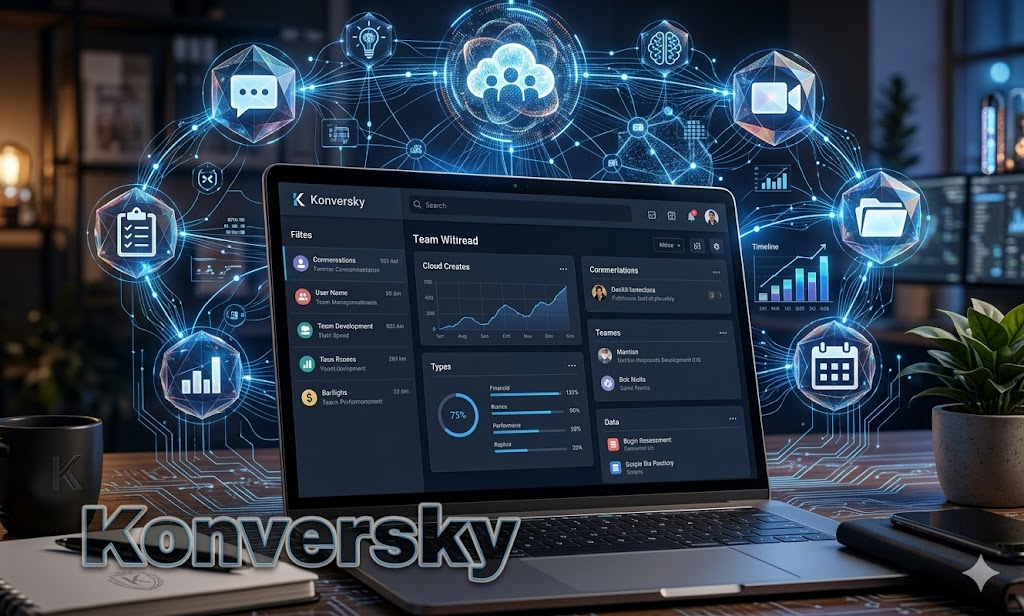
Konversky is rapidly becoming one of the most searched terms in the digital marketing and business technology space — and for good reason. As AI-driven tools redefine how brands communicate, engage, and convert, this platform sits at the intersection of automation, personalization, and intelligent workflow design.
In 2026, 72% of consumers expect real-time engagement from the brands they interact with. Legacy tools — isolated CRMs, rigid chatbots, disconnected email platforms — are increasingly failing to meet this demand. Businesses are searching for a unified, adaptive, and emotionally intelligent system that does more than broadcast messages. They need something that listens, learns, and responds. That is precisely the gap konversky fills.
This comprehensive guide breaks down everything you need to know: what the platform is, how it works, the core features that set it apart, its real-world applications across industries, how it compares to traditional alternatives, and what the future holds. Whether you are a startup founder, digital marketer, enterprise manager, or a curious technology enthusiast, this guide is built to give you clarity, depth, and actionable insight.
What Is Konversky? A Clear, Comprehensive Definition
At its most fundamental level, konversky is an AI-powered conversational engagement and workflow platform. It combines natural language processing (NLP), machine learning, predictive analytics, sentiment analysis, and multi-channel communication into a single, unified digital ecosystem. Rather than functioning as just another chatbot or messaging tool, it operates as an adaptive intelligence layer that sits across all of your customer-facing and internal communication channels.
The name itself is telling. The root “Konvers” pulls from the concepts of conversation, convergence, and conversion — three things that sit at the heart of every meaningful business interaction. The suffix “-sky” gives the brand a sense of limitless possibility and modern identity. Together, they represent a platform that is simultaneously conversational, transformative, and boundary-pushing.
In practical terms, konversky enables businesses to:
- Automate customer support conversations without losing the human touch
- Integrate social media, email, SMS, and live chat into a single dashboard
- Analyze sentiment and behavioral signals in real time
- Predict user intent before customers even articulate their needs
- Generate multilingual support across more than 50 languages
- Track engagement metrics and funnel performance through intelligent dashboards
Unlike traditional CRM systems that store customer data passively, this platform actively interprets that data, responds to it, and uses it to improve every future interaction. It is the difference between a database and a dialogue.
The Origin and Evolution of Konversky
Understanding where konversky came from helps explain why it resonates so powerfully with modern businesses. The platform did not emerge overnight. Its development tracked closely with the evolution of three converging trends: the rise of AI and NLP technology, the shift in consumer expectations toward real-time personalization, and the fragmentation of digital communication channels.
In the early days of digital marketing, businesses relied on intuition and broad campaign strategies. Email blasts, banner ads, and cold outreach were the primary tools. Conversion optimization was largely guesswork. Marketers measured success by impressions and clicks, with little understanding of why certain messages worked and others did not.
As machine learning matured, so did the sophistication of customer engagement tools. Chatbots arrived with the promise of automation but often delivered scripted, frustrating experiences. A/B testing brought data into the picture but still required human interpretation and manual action.
Konversky emerged to fill the growing gap between raw automation and genuine intelligence. Early adopters — innovators, entrepreneurs, and forward-thinking digital teams — recognized its potential to unify scattered workflows, deepen customer understanding, and drive conversions through empathy rather than volume. What began in creative and digital-native spaces quickly expanded into mainstream enterprise adoption. Today, the platform influences business practices, communication strategies, and the broader digital culture across industries and continents.
Core Features That Define the Platform
AI-Driven Conversation Intelligence
The backbone of konversky is its natural language processing engine. Unlike keyword-triggered chatbots that react to surface-level inputs, this system interprets nuance, emotion, cultural context, and conversational flow. It distinguishes between a frustrated customer needing immediate resolution and a casual visitor in early-stage exploration. It adapts its tone, pacing, and response style accordingly — not because it follows a script, but because it understands.
Machine learning algorithms continuously refine this understanding. Every conversation trains the model further, so the system becomes more accurate and more empathetic over time. The result is a platform that feels genuinely responsive rather than mechanically reactive.
Sentiment Analysis and Emotional Intelligence
One of the most differentiating features of konversky is its real-time sentiment analysis. The system evaluates the emotional tone of every incoming message — not just the words, but the implied feeling behind them. It detects frustration, excitement, hesitation, urgency, and satisfaction, then tailors its responses to match and guide those emotional states toward positive outcomes.
For customer service teams, this means fewer escalations. For sales teams, it means better-timed follow-ups. For marketing teams, it means messages that land with precision rather than approximation. Emotional intelligence, long considered an exclusively human trait, is now a measurable and deployable feature of intelligent business communication.
Predictive Analytics and Proactive Engagement
Rather than waiting for customers to initiate conversations, konversky uses predictive analytics to identify moments where proactive engagement is most likely to drive value. By analyzing behavioral patterns — browsing history, cart activity, session duration, past interactions — the platform anticipates needs and surfaces relevant content, offers, or support before the customer asks.
A visitor lingering on a pricing page for more than 90 seconds might receive a timely, personalized message from a sales bot. A customer who abandoned their cart yesterday might receive a contextually relevant follow-up with a tailored incentive. These micro-moments of anticipation dramatically improve conversion rates while reducing the friction that causes drop-offs in traditional funnels.
Omnichannel Integration
Modern consumers do not live on a single channel. They move fluidly between social media, email, SMS, live website chat, voice calls, and mobile applications. Konversky integrates all of these touchpoints into a unified communication dashboard. Messages are synchronized across channels, conversation history is preserved regardless of which platform the customer uses, and teams can manage every interaction from a single, coherent workspace.
This omnichannel fluency eliminates the fragmented experience that customers encounter when switching between platforms — a common pain point that damages brand trust and increases churn. With konversky, the conversation continues seamlessly, regardless of where it began.
Real-Time Multilingual Support
Konversky delivers real-time language translation across more than 50 languages while preserving the original meaning, tone, and cultural nuance of every message. This is not a simple word-for-word converter; it is a context-aware translation engine that understands industry-specific vocabulary, regional idioms, and conversational subtext.
For global teams and internationally minded businesses, this feature dissolves language barriers entirely. A sales representative in one country can communicate naturally with a customer in another, with both parties receiving instant, accurate translations in their native languages. The business implications are profound: markets that were once inaccessible due to language gaps become fully reachable.
Workflow Automation and Task Management
Beyond conversation, konversky automates repetitive tasks that drain team resources. Routine inquiries — order tracking, appointment scheduling, FAQ responses, account updates — are handled automatically, freeing human agents to focus on complex, high-value interactions that require judgment and creativity.
The platform integrates with leading CRM systems, marketing automation tools, e-commerce platforms, and ERP solutions. Data flows effortlessly between systems, eliminating silos and enabling teams across marketing, sales, and customer service to operate in synchronized harmony. Drag-and-drop workflow builders make automation accessible without requiring deep technical expertise.
Advanced Analytics and Performance Dashboards
Data is only valuable when it is actionable. Konversky’s analytics suite provides real-time visibility into conversation performance, engagement rates, sentiment trends, channel effectiveness, and conversion outcomes. Custom dashboards allow teams to monitor the metrics that matter most to their specific objectives.
Beyond reporting on what has already happened, the platform’s predictive modeling capabilities use historical data to forecast future trends, identify at-risk customers, and surface optimization opportunities before problems emerge. This transforms analytics from a retrospective exercise into a forward-facing strategic tool. how is it possible for ski jumpers to stay in the air so long and how do they train for that?
How Konversky Works: A Step-by-Step Breakdown
Understanding the mechanics behind the platform demystifies its capabilities and makes implementation feel less daunting. Here is how konversky operates in practice:
Step 1 — Data Ingestion: The platform connects to all existing communication channels and data sources — your website, CRM, email system, social media accounts, and support tickets. It begins building a unified profile of each customer by aggregating interaction history, behavioral signals, and demographic data.
Step 2 — Intent Recognition: When a customer initiates a conversation, the NLP engine analyzes the input in real time, determining intent, emotional tone, and contextual relevance. The system does not react to surface-level keywords; it understands meaning.
Step 3 — Response Generation: Based on the interpreted intent and emotional tone, the platform generates a contextually appropriate response. This response may come from a pre-trained AI model, a knowledge base, or a human agent prompted by the system’s suggestion engine — depending on the complexity of the inquiry.
Step 4 — Escalation Management: When a conversation exceeds the AI’s optimal handling capacity — due to emotional complexity, legal sensitivity, or highly specific customer needs — the platform intelligently escalates to a human agent, providing that agent with a full conversation summary and sentiment analysis so they can pick up seamlessly.
Step 5 — Learning and Optimization: Every resolved conversation becomes training data. The machine learning algorithms update the model continuously, improving accuracy, reducing resolution times, and refining the platform’s understanding of customer behavior over time.
Step 6 — Reporting and Insight: After every interaction cycle, the analytics suite generates performance reports, identifies patterns, and surfaces actionable recommendations. Teams use these insights to refine scripts, adjust automation triggers, and improve campaign targeting.
Industry Applications: Who Is Using Konversky and How
E-Commerce and Retail
For online retailers, conversion optimization is a constant battle. Abandoned carts, unclear product information, slow support responses, and impersonal shopping experiences all contribute to lost revenue. Konversky addresses each of these pain points through intelligent automation and real-time engagement.
When a visitor abandons their cart, the platform triggers a personalized follow-up conversation offering relevant incentives. When a product question goes unanswered on a product page, a proactive chat prompt surfaces the information before the visitor navigates away. Customer service interactions are handled around the clock through AI-powered agents trained on product catalogs, return policies, and shipping information. The result is a shopping experience that feels personal, responsive, and frictionless — even at scale.
Healthcare and Patient Communication
In healthcare, communication errors and delays can have serious consequences. Konversky supports patient-facing applications by automating appointment scheduling, sending medication reminders, routing inquiry calls, and providing multilingual support for diverse patient populations.
The sentiment analysis feature is particularly valuable in this context. Patients under stress or confusion communicate differently than calm, informed individuals. The platform’s emotional intelligence capabilities allow healthcare providers to identify distressed patients and route them to human care coordinators immediately, ensuring that automated efficiency never comes at the cost of human compassion.
Financial Services
Banks, insurance companies, fintech startups, and investment platforms use the capabilities of konversky to streamline client onboarding, answer product inquiries, detect fraud signals in conversation patterns, and deliver personalized financial guidance through AI-powered advisors.
The platform’s security framework — including end-to-end encryption and compliance-ready data handling — makes it appropriate for highly regulated environments. Clients receive the immediacy and personalization they expect from digital-first interactions, while institutions maintain the audit trails and data governance standards required by regulatory bodies.
Education and EdTech
Educational institutions and online learning platforms use konversky to power virtual classrooms, student support systems, and administrative communication workflows. Teachers receive AI-assisted tools for managing student inquiries, distributing course materials, and tracking engagement patterns. Students benefit from personalized learning nudges, instant feedback on submissions, and 24/7 access to support resources.
In the EdTech space specifically, the platform’s multilingual capabilities are transformative. Online courses with global student bases can communicate meaningfully with learners in their native languages, dramatically improving comprehension, retention, and satisfaction rates.
Marketing Agencies and Digital Teams
For marketing professionals, konversky serves as a conversion optimization engine. Campaign performance data, customer behavior analytics, and real-time sentiment tracking give marketers the insight they need to craft messages that resonate deeply rather than broadly. A/B testing is enhanced by AI-generated variant suggestions based on behavioral data. Lead nurturing sequences become adaptive rather than linear, responding to each prospect’s behavior rather than following a rigid timeline.
Agencies managing multiple client accounts use the omnichannel dashboard to coordinate campaigns, track results, and generate client reports — all from within a single integrated platform.
Konversky vs. Traditional Communication and CRM Tools
To fully appreciate the value of this platform, it helps to compare it against the tools it is designed to replace or augment.
| Feature | Traditional CRM | Standard Chatbot | Konversky |
|---|---|---|---|
| Real-time sentiment analysis | No | No | Yes |
| Predictive engagement | Limited | No | Yes |
| Omnichannel integration | Partial | No | Yes |
| Multilingual support | No | Limited | 50+ languages |
| Emotional intelligence | No | No | Yes |
| Workflow automation | Basic | Scripted | Advanced |
| Machine learning adaptation | No | No | Continuous |
| Scalability | Moderate | Limited | High |
| Analytics depth | Retrospective | Minimal | Predictive |
Traditional CRM tools excel at storing and organizing customer data, but they lack the real-time conversational intelligence that modern engagement demands. Standard chatbots automate responses efficiently but follow rigid scripts that frustrate customers the moment a conversation deviates from an anticipated path. Konversky bridges both gaps — combining data depth with conversational agility and genuine learning capability.
The key differentiator is adaptability. While legacy tools enforce static structures, this platform evolves continuously. It learns from every interaction, adjusts to shifting behavioral patterns, and updates its response logic without requiring manual reprogramming. For businesses operating in fast-moving markets, this adaptive intelligence is not a luxury — it is a necessity.
Implementation: Getting Started with Konversky
Implementing any new platform requires careful planning, stakeholder alignment, and a phased rollout strategy. Here is a practical framework for integrating konversky into your existing operations:
Phase 1 — Audience Mapping: Before activating any features, identify the customer touchpoints where conversations naturally occur. Where do customers reach out? What are the most common inquiries? Where do current workflows break down? This mapping exercise ensures that automation is applied where it will have the greatest impact.
Phase 2 — Channel Integration: Connect the platform to your existing channels — website chat, email, social media, SMS, and phone systems. Ensure that data flows cleanly between the platform and your CRM, e-commerce system, or ERP. The goal at this stage is a unified, connected data environment.
Phase 3 — Training and Configuration: Configure the AI models using your existing knowledge base, product documentation, customer service scripts, and historical conversation data. The more context you provide at this stage, the more accurate and brand-aligned the system’s responses will be from day one.
Phase 4 — Team Enablement: Train your customer service, sales, and marketing teams to work alongside the AI. Define clear escalation protocols so that human agents know when and how to take over from the automated system. Establish the collaborative dynamic that positions the AI as an assistant rather than a replacement.
Phase 5 — Launch and Monitor: Deploy the platform across your target channels with close monitoring during the initial weeks. Use the real-time analytics dashboard to track performance, identify unexpected behaviors, and make rapid adjustments. Establish baseline KPIs — response time, resolution rate, sentiment score, conversion rate — that allow you to measure impact objectively.
Phase 6 — Optimize Continuously: Use the platform’s machine learning feedback loops and performance reports to refine your configuration on an ongoing basis. The system improves with use, but human-led optimization accelerates that improvement. Schedule regular review sessions where your team analyzes insights and implements strategic adjustments.
The Business Case: What Results Can You Expect?
The business case for adopting konversky is compelling across multiple dimensions. Organizations that have implemented the platform report measurable improvements in several key areas:
Response Time Reduction: Companies using konversky have reduced average response times by up to 40%. In customer service, faster responses directly correlate with higher satisfaction scores and lower churn rates.
Conversion Rate Improvement: By applying predictive engagement and behavioral personalization, businesses have reported significant increases in conversion rates across e-commerce, lead generation, and sales pipeline workflows. Proactive outreach at the right moment — triggered by behavioral signals — consistently outperforms reactive, volume-based approaches.
Cost Efficiency: Automating routine customer service interactions reduces the operational burden on human agents, allowing companies to handle higher inquiry volumes without proportional increases in headcount. This efficiency gain is particularly impactful for scaling businesses where growth in customer base often outpaces hiring capacity.
Customer Retention: Emotionally intelligent, personalized communication builds the kind of trust that drives long-term loyalty. Customers who feel understood and valued return more frequently, spend more per transaction, and refer others at higher rates. The platform’s sentiment tracking and follow-up automation keep relationships warm between purchases or interactions.
Team Productivity: Internal communication features — task management, collaboration tools, synchronized knowledge bases — reduce the friction that slows cross-departmental work. Teams spend less time searching for information, less time managing redundant communications, and more time on the creative and strategic work that drives genuine business value.

The Philosophy Behind the Platform: More Than a Tool
One of the more interesting dimensions of konversky is its philosophical underpinning. The most sophisticated observers of this platform note that it is not simply a productivity tool or a marketing technology — it is a reflection of a broader shift in how we understand communication in the digital age.
Traditional digital tools were built on a broadcast model: one message to many recipients, optimized for reach. The emerging model — of which this platform is a leading example — is built on a dialogue model: individualized conversations at scale, optimized for meaning. This is not just a technological evolution; it is a cultural one.
The platform embodies the idea that technology should enhance human connection rather than replace it. Its emotional intelligence features are not designed to simulate humanity artificially, but to ensure that the efficiency of automation never strips away the warmth, responsiveness, and contextual awareness that make communication feel genuinely human. Brands that adopt this philosophy — and use the platform to operationalize it — create customer relationships that are qualitatively different from those built on volume-based, impersonal engagement strategies.
This is why konversky resonates not just in corporate boardrooms and marketing departments, but in educational institutions, healthcare settings, nonprofit organizations, and creative communities. Its value is not vertical-specific; it is universal, because the need for meaningful, intelligent, responsive communication is universal.
Security, Privacy, and Data Ethics
As with any platform that handles sensitive customer data and conversation content, security and privacy are paramount. Konversky is built with enterprise-grade security standards that address the most pressing concerns of modern data governance.
End-to-end encryption protects all conversations from interception, ensuring that sensitive information shared between customers and businesses remains confidential. Role-based access controls limit visibility of customer data to authorized team members only. Comprehensive audit trails log all system activities, supporting compliance with major regulatory frameworks including GDPR, CCPA, and HIPAA-adjacent requirements in healthcare contexts.
The platform’s data ethics framework goes beyond compliance. It is designed to collect only the data necessary for effective personalization, to give users meaningful control over their own information, and to ensure that AI decision-making is transparent and auditable. In an era where consumer trust is a fragile and essential asset, this commitment to responsible data stewardship is both an ethical imperative and a competitive advantage.
Challenges and Considerations
No platform, regardless of how advanced, is without its limitations. A balanced assessment of konversky includes an honest acknowledgment of the challenges businesses may encounter during adoption and ongoing use.
Initial Configuration Complexity: The platform’s power comes from its depth of configuration. For teams without prior experience in AI platform deployment, the initial setup — connecting data sources, training models, defining automation triggers — can feel complex. Investing in proper onboarding support and phased implementation mitigates this challenge significantly.
Change Management: Introducing AI-powered automation into established customer service or sales teams requires careful change management. Team members may feel uncertain about how AI will affect their roles. Clear communication, proper training, and a collaborative deployment model — in which the AI augments rather than displaces human work — are essential to successful adoption.
Data Quality Dependency: The accuracy and effectiveness of the platform’s AI features depend heavily on the quality of the data it is trained on. Organizations with fragmented, inconsistent, or outdated customer data may find that initial performance falls short of expectations. A data audit and cleansing process prior to implementation helps ensure a stronger foundation.
Evolving Standardization: As konversky continues to grow and evolve as a concept and platform, some aspects of its implementation are not yet fully standardized across all use cases. Businesses should plan for iterative optimization rather than expecting perfection from day one.
Future Trends: Where Konversky Is Headed
The trajectory of this platform is shaped by the same forces that are reshaping the entire landscape of digital communication: advances in generative AI, the proliferation of voice interfaces, the mainstreaming of augmented reality experiences, and the growing demand for hyper-personalization at scale.
In the near term, expect deeper integration between konversky-type platforms and voice-enabled devices. As smart speakers, voice search, and voice-first interfaces become increasingly central to how people interact with technology, the conversational intelligence that defines this platform will extend seamlessly into audio environments.
The integration of generative AI capabilities — already underway — will further expand the platform’s ability to create original, contextually relevant content in real time. Instead of selecting from pre-written response templates, the system will generate unique, brand-aligned messages tailored to each individual interaction.
Augmented reality and spatial computing represent a longer-horizon frontier. As AR environments become more commercially viable, the conversational layer that platforms like this provide will extend into immersive digital spaces, enabling customer engagement in entirely new dimensions.
Finally, the broader adoption of konversky principles — real-time personalization, sentiment intelligence, predictive engagement, omnichannel fluency — will gradually become baseline expectations rather than competitive differentiators. Businesses that adopt these capabilities now will be positioned as leaders rather than followers when the broader market catches up.
FAQs
What exactly is konversky and how does it differ from a traditional chatbot?
Konversky is a full AI-powered communication and engagement platform, not simply a chatbot. Traditional chatbots operate on fixed scripts and trigger-based responses, meaning they can only handle inquiries that fall within their pre-programmed parameters. The moment a customer asks something unexpected, the chatbot fails. This platform, by contrast, uses advanced natural language processing and continuous machine learning to understand intent, interpret emotion, and adapt responses dynamically. It improves with every conversation rather than remaining static, and it integrates across all communication channels rather than operating as an isolated widget.
Is konversky suitable for small businesses, or is it designed primarily for enterprises?
The platform is designed to scale across business sizes. Small businesses benefit from its ability to automate routine customer service tasks — freeing founders and small teams from repetitive inquiry management — while its affordable entry-level configurations make it accessible without enterprise budgets. Larger organizations benefit from its advanced analytics, complex workflow automation, and multi-team collaboration features. The key is that the platform adapts to your operational scale rather than imposing a fixed structural requirement.
How long does it take to implement and see results from konversky?
Implementation timelines vary based on the complexity of your existing systems and the depth of configuration required. A basic deployment — connecting primary channels, configuring core automation, and training the AI on your knowledge base — can typically be accomplished within a few weeks. More comprehensive integrations involving multiple CRM systems, custom workflow automation, and advanced analytics configuration may take one to three months. Most businesses begin to see measurable improvements in response times and customer satisfaction within the first 30 days of active deployment.
Does konversky support integration with existing CRM and marketing platforms?
Yes. The platform is designed with integration-first architecture, supporting seamless connections to the most widely used CRM platforms, marketing automation tools, e-commerce systems, and ERP solutions. APIs and pre-built connectors facilitate data flow between konversky and your existing technology stack, ensuring that customer data is synchronized across all systems without manual reconciliation.
How does the platform handle data privacy and security?
Data security is built into the platform’s architecture at every layer. All conversations are protected by end-to-end encryption. Role-based access controls ensure that customer data is only visible to authorized personnel. Comprehensive audit logs support regulatory compliance, and the platform’s data governance framework is aligned with major international privacy regulations. Businesses operating in regulated industries — healthcare, finance, legal — should work with implementation specialists to ensure that their specific compliance requirements are fully addressed.
Can konversky handle multiple languages, and how accurate is the translation?
The platform supports real-time multilingual communication across more than 50 languages. Its translation engine is context-aware, meaning it preserves not only literal meaning but also tone, cultural nuance, and industry-specific vocabulary. This distinguishes it from simple machine translation tools that produce technically accurate but contextually awkward output. For global businesses, this feature effectively removes language as a barrier to customer engagement.
What industries benefit most from implementing this platform?
While the platform’s capabilities are broadly applicable, several industries have reported particularly strong results: e-commerce and retail, where real-time engagement and cart recovery automation drive measurable revenue impact; healthcare, where sentiment analysis and multilingual support improve patient communication; financial services, where secure, personalized advisory experiences build client trust; education, where adaptive learning communication tools improve student outcomes; and marketing and digital agencies, where campaign optimization and multi-client management features drive efficiency and performance.
Conclusion: Why Konversky Represents the Future of Digital Communication
We stand at an inflection point in the history of business communication. The tools of the previous decade — isolated, passive, volume-focused — are no longer adequate for the expectations of modern customers or the complexity of global markets. The future belongs to platforms that are intelligent, adaptive, empathetic, and integrated.
Konversky represents precisely this future. By combining advanced NLP, machine learning, sentiment analysis, predictive engagement, omnichannel fluency, and real-time analytics into a unified platform, it redefines what business communication can accomplish. It does not simply automate conversations; it elevates them. It does not merely manage customer data; it transforms that data into meaningful, timely, and personalized interactions that build lasting loyalty.
For businesses willing to invest in the implementation process, align their teams around a customer-centric communication philosophy, and commit to continuous optimization, the returns are substantial and compounding. Response times fall, conversion rates rise, customer satisfaction improves, operational costs decrease, and the quality of every interaction — internal and external — reaches new levels of consistency and intelligence.
The digital landscape will continue to evolve. Consumer expectations will continue to rise. The competitive premium on intelligent, personalized, real-time communication will only increase. Businesses that recognize this trajectory and act on it now — by adopting platforms built for the era we are entering rather than the one we are leaving — will define the standards that others eventually follow.
Konversky is not simply a trend. It is a signal of where digital communication, business technology, and customer relationship management are all converging. And for businesses ready to lead rather than catch up, that convergence is the most important competitive opportunity of 2026.