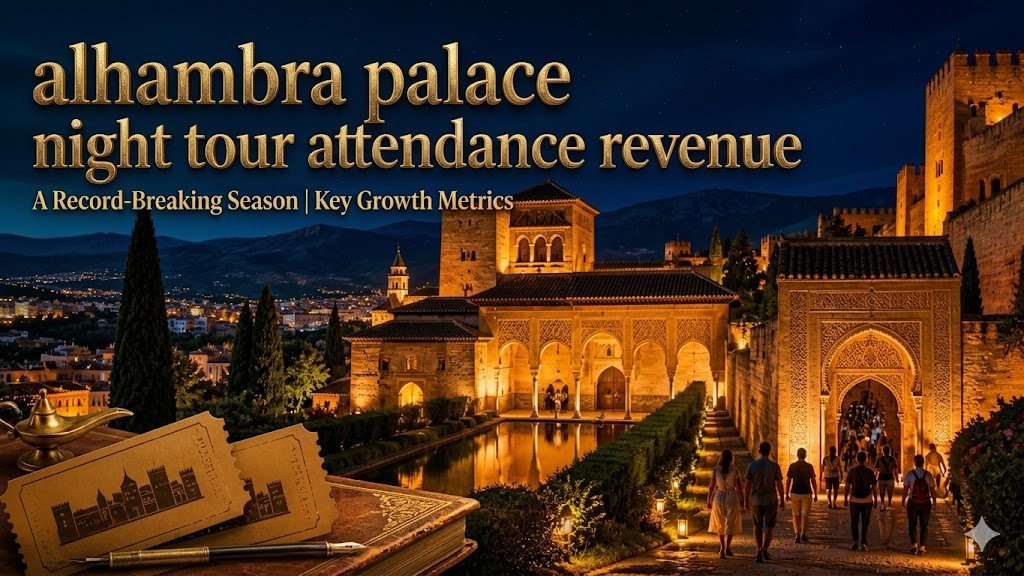
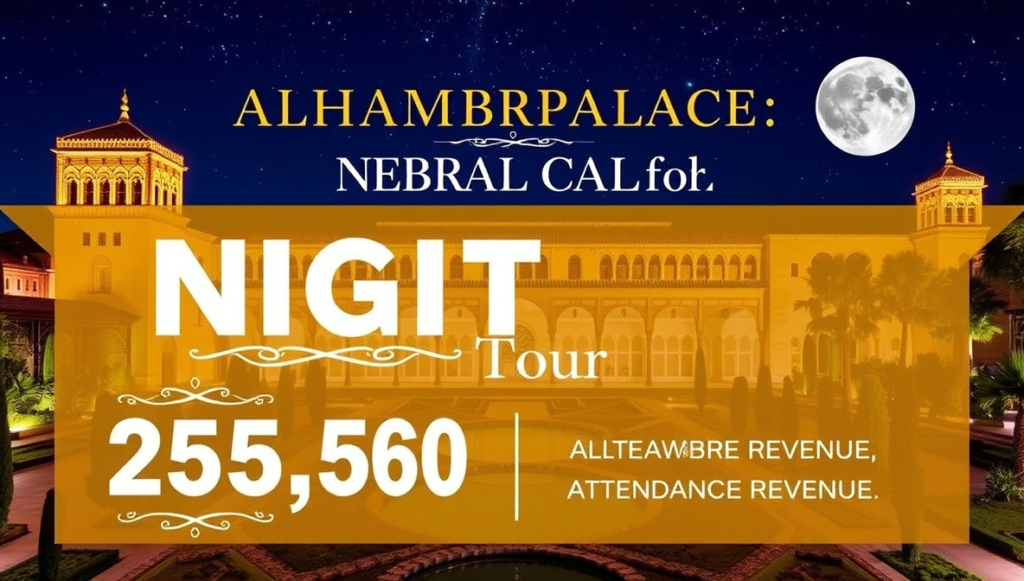
Alhambra Palace Night Tour Attendance Revenue is one of the most carefully studied subjects in European cultural tourism economics, offering powerful lessons about how heritage sites can balance preservation, visitor experience, and financial sustainability without sacrificing any of the three.
When the sun dips behind the Sierra Nevada and daylight releases its grip on the ancient hilltop of Sabika, something remarkable happens in Granada. The Alhambra — one of the greatest surviving monuments of Islamic civilization in the western world — transforms. The white noise of thousands of daytime visitors dissolves into stillness. Specially designed lighting draws out the geometry of carved stucco in ways that sunlight never quite manages. Fountains that seem ordinary under a tourist crowd become meditative in the quiet dark. This is the world of the Alhambra after hours, and understanding the full picture of Alhambra Palace Night Tour Attendance Revenue means understanding both the unique atmosphere of these evening experiences and the sophisticated economic system that surrounds them.
This article covers everything: the history and architecture that makes the Alhambra worth visiting at any hour, the specific design of the night tour program, visitor numbers, ticket pricing structures, seasonal patterns, the economic impact on Granada, the conservation relationship that binds income to preservation, and the future direction of evening access at one of Spain’s most visited cultural landmarks.
The Alhambra: Setting the Stage for an Evening of History
Before examining the economics, it is worth understanding why the Alhambra occupies such a singular place in world heritage. Built primarily during the 13th and 14th centuries under the Nasrid dynasty — the last Islamic kingdom to rule in Western Europe — the complex perched on the Sabika hill above Granada is widely considered the finest surviving example of Nasrid art and Islamic palatine architecture anywhere in the world.
The name itself derives from the Arabic al-qal’a al-hamra, meaning red fort or castle, a reference to the reddish walls and towers that define the complex’s exterior silhouette against the Granada skyline. Inside, however, those austere walls give way to something entirely different. The Nasrid Palaces, which form the emotional and architectural heart of the complex, display an interior world of breathtaking refinement: tiled plinths in geometric patterns, mural plasterwork so intricate it appears almost like fabric draped over stone, coffered wooden ceilings that seem to defy the structural logic of their construction, and open courtyards arranged around fountains and reflecting pools that have inspired architects and artists for centuries.
The complex encompasses several distinct areas that visitors explore across their time on the hill. The Alcazaba fortress occupies the western promontory and represents the earliest military core of the site. The Nasrid Palaces, comprising the Mexuar, the Palace of Comares, and the Palace of the Lions, form the sovereign residential quarter and are the most ornate structures in the complex. The Generalife, to the east, served as the summer palace and gardens of the Nasrid emirs, incorporating a sophisticated system of hydraulic engineering that kept the terraced gardens irrigated across the dry Andalusian summers. The Palace of Charles V, a Renaissance structure begun in 1526 after the Christian reconquest, adds a later architectural layer that coexists with — and deliberately contrasts against — the surrounding Islamic structures.
The Alhambra constitutes the best example of Nasrid art in its architecture and decorative aspects, and the Generalife Garden represents one of the few medieval areas of agricultural productivity, made possible by the existing irrigation engineering of Al-Ándalus, combining architecture and landscape into a real urban system.
In 1984, the Alhambra was designated a UNESCO World Heritage Site along with two other related sites: the Albaicín and the Generalife Garden, and it remains the only surviving palatine city of the Islamic Golden Age.
This designation formalized what travelers had understood for generations: the Alhambra is not simply a tourist attraction. It is an irreplaceable artifact of human civilization, and every decision about how it is accessed, used, and managed must be made with that irreplaceability in mind.
Why Night Tours Exist: The Logic Behind After-Hours Access
The decision to open the Alhambra to visitors in the evening was not made arbitrarily. It emerged from a combination of visitor management strategy, conservation necessity, and the recognition that the site offers something genuinely different after dark.
Daytime visitor pressure at the Alhambra is intense. The overall Alhambra complex welcomes approximately 2.6 to 2.7 million visitors annually, making it one of Europe’s most visited cultural landmarks. Managing that volume while protecting fragile 14th-century plasterwork, wooden ceilings, and garden landscapes requires constant active planning. Night tours were introduced partly as a tool for distributing that pressure — extending the hours of operation without simply adding more visitors to the already crowded daytime windows.
But the evening program quickly became something more than a pressure valve. Visitors who experienced the Nasrid Palaces at night began reporting that it felt like an entirely different monument. The reduction in crowd noise, the effect of purpose-designed illumination on the carved surfaces, and the cooler temperatures of evening all combined to create an atmosphere that daytime visits, however memorable, could not replicate. This atmospheric distinction became the foundation of the premium experience model that defines the night tour today.
Night tours at the Alhambra are designed to prioritize a calm and immersive atmosphere over volume. The lighting design highlights architectural details that are often missed during daytime visits, and the silence, reduced crowding, and controlled access create a more intimate experience.
The Patronato de la Alhambra y Generalife — the governing body responsible for managing the complex — recognized that this distinctive character also represented a distinct economic opportunity. If visitors were willing to pay premium prices for access to a premium experience, the night tour could generate meaningful income from a carefully limited number of visitors, rather than requiring the kind of mass volume that would accelerate damage to historic structures. This insight forms the philosophical core of the entire night tour revenue model.
Understanding the Night Tour Program Structure
The Alhambra’s evening access is not a single undifferentiated product. It is structured as a set of distinct offerings that operate on different schedules, serve different parts of the complex, and appeal to different visitor profiles.
The Nasrid Palaces Night Visit is the flagship evening experience and the one that draws the highest demand. Access is limited to the Mexuar, the Palace of Comares, and the Palace of the Lions — the three principal sections of the palace quarter. Visitors move through these spaces under carefully calibrated artificial lighting that has been designed to highlight specific architectural features: the geometric stalactite vaulting of the muqarnas ceilings, the reflection of illuminated arches in the pool of the Court of the Myrtles, and the intricate calligraphic bands that run across the surfaces of interior walls.
The main attraction is the Nasrid Palaces Night Visit — an intimate journey through the heart of Moorish artistry, where intricate stucco carvings and silent courtyards feel entirely different without the daytime crowds pressing in. Separately, the Gardens and Generalife Night Visit offers a tranquil walk through the illuminated summer palace and its fragrant grounds, running only during spring and autumn months, making it even more exclusive.
This seasonal restriction on the Generalife night program is deliberate. The garden environment is sensitive to intensive use, and limiting evening access to the more temperate months reduces wear on paths, plantings, and the hydraulic systems that keep the gardens functioning. It also reinforces the sense of exclusivity that supports premium pricing: when a product is available for only part of the year, demand concentrates and perceived value rises.
Tiered ticket options allow the Alhambra to serve different visitor needs within the evening program. Tiered options for Nasrid Palaces versus Generalife versus combined experiences allow visitors to choose based on interest and budget, while discounted rates for residents, students, and seniors support accessibility. This tiering serves both economic and social purposes — maximizing revenue from visitors willing to pay full price for the complete experience while maintaining access for residents and student groups whose connection to the cultural heritage carries its own value.
Attendance Figures: How Many People Visit at Night?
One of the most frequently asked questions about Alhambra Palace Night Tour Attendance Revenue concerns the actual visitor numbers involved. How many people attend evening sessions each year, and how does that compare to overall Alhambra attendance?
On average, night tours attract approximately 120,000 to 150,000 visitors per year. This includes Nasrid Palace night visits, garden-focused evening tours, and official guided night programs. Night tours represent only a small portion of total attendance, but they are strategically important, redistributing visitor flow, reducing daytime pressure, and creating an additional revenue stream.
These figures need context. In a complex that receives close to three million visitors annually, 120,000 to 150,000 evening visitors represents roughly five percent of total attendance. That is a small proportion in absolute terms, but it is important to understand that the night tour was never designed to be a mass-market product. Its value lies precisely in its smallness: the limited capacity that makes it exclusive, the reduced volume that makes it intimate, and the premium that both those qualities justify.
Peak summer nights may attract 400 to 500 guests in a single evening, while off-season nights usually receive 200 to 300 visitors. These session-level figures help explain the operational structure. Each night tour window admits a fixed group, and the rhythm of arrivals is carefully controlled to prevent congestion in the palace corridors.
Night tours of the Nasrid Palaces are limited to around 300 visitors per 30-minute slot, and due to strict capacity, night tours often sell out months in advance. Visitors are advised to book up to three months ahead. This advance booking requirement is not merely an administrative inconvenience — it is a core feature of the economic model. When tickets sell out months before the date of the visit, the Patronato can plan operations, staffing, and conservation interventions with a level of financial predictability that most heritage sites cannot achieve. insoya
Revenue Structure: Where the Money Comes From
Alhambra Palace Night Tour Attendance Revenue does not derive from a single source. The income generated through evening access flows from several interconnected streams, each contributing to the overall financial picture.
Ticket Sales
Direct ticket revenue is the largest and most straightforward component. Visitors pay approximately €12.73 for a night visit to the Nasrid Palaces, a price point that reflects a balanced approach to accessibility and revenue. Because these tickets sell out weeks in advance, night tour revenue provides a predictable and steady stream of income that supports the monument’s extensive daily operations.
The mathematics of ticket revenue are relatively transparent. If 150,000 visitors attend night tours annually and the average ticket price is approximately €12, the direct ticket revenue from the Nasrid Palaces night program approaches €1.8 million per year. This calculation, which excludes separate garden tours and premium tickets, places the baseline revenue close to €1.8 to €2 million annually, revealing a stable, significant income stream built on a deliberate low-volume, high-value model.
Guided Tour Packages
Beyond basic entry, visitors can purchase official and third-party guided tour packages that significantly increase revenue per visitor. Official night tour tickets typically range between €7 and €10 for basic access, while private tours can exceed €180 per group. This wide price range captures visitors across the full spectrum of willingness to pay — from budget-conscious travelers who want basic evening entry to high-spending cultural tourists who want a private, expert-led exploration of the palace.
Audio Guides and Supplementary Experiences
Multilingual audio guides represent a consistent additional revenue layer that requires minimal incremental staffing. Visitors who prefer to move at their own pace through the palaces can supplement their experience with professionally produced audio commentary, adding to per-visit spending without adding to visitor numbers.
Merchandise and Secondary Spending
Even within the controlled environment of a night tour, select retail offerings contribute to revenue. Books, architectural replicas, and exclusive items tied to the Alhambra collection provide additional income for visitors who want a physical memento of their evening experience.
The combination of these streams means that revenue per visitor on a night tour is substantially higher than on a standard daytime visit. The key insight is that revenue per visitor is significantly higher than daytime tours, making night tours financially efficient. Alhambra Palace Night Tour Attendance Revenue is built on value per visitor, not mass tourism.
Seasonal Patterns and Revenue Fluctuation
Like all tourism products, the night tour program at the Alhambra experiences significant seasonal variation in both attendance and revenue. Understanding these patterns is essential for anyone studying the economic dimensions of the program.
Demand for Alhambra night tours follows clear seasonal patterns. Spring (March to May) sees visitor numbers increase as European tourists begin traveling; temperatures are comfortable, evenings are pleasant, and night tours sell out regularly. Summer (June to August) represents peak season for international tourism, with night tours extremely popular because daytime temperatures in Granada frequently exceed 35 degrees Celsius, making an evening visit far more comfortable. Autumn (September to November) sees demand remain solid, particularly in September and October.
The summer premium is particularly significant from a revenue perspective. When daytime temperatures in Andalusia become genuinely difficult for outdoor sightseeing, the evening hours acquire not just cultural appeal but practical desirability. Visitors who might otherwise have spent a hot afternoon inside an air-conditioned restaurant or hotel choose instead to visit the Alhambra in the cool of the evening, where the fountains and the garden pathways are far more pleasant than they would be at midday.
Winter months present a different picture. Fewer night tours operate during winter, while warm weather increases tourism and more night visits operate during summer months. The reduction in winter programming reflects both reduced visitor demand and the practical reality that evening temperatures in Granada during December and January can be quite cold, making extended outdoor sessions in the Generalife gardens less appealing. However, the Nasrid Palaces themselves remain available for evening access year-round, maintaining a baseline revenue contribution even through the quieter months.
This seasonal structure creates a revenue profile that peaks sharply in summer and tapers in winter, requiring careful financial planning by the Patronato to ensure that high-season income covers the ongoing costs of conservation and operation throughout the year.
The Economic Impact Beyond the Ticket Booth
Any thorough analysis of Alhambra Palace Night Tour Attendance Revenue must extend beyond the direct income received by the Patronato de la Alhambra y Generalife. The economic effects of the night tour program ripple outward into the city of Granada in ways that benefit businesses, workers, and communities far removed from the palace gates.
The Alhambra is the economic heart of Granada. A landmark study confirmed that the monument generates a staggering €490 million in total economic impact for the city annually and supports over 6,800 jobs in Granada alone. The breakdown is striking: 83% of hotel income in Granada is attributable to the Alhambra.
While that total figure encompasses all Alhambra visits rather than night tours specifically, the evening program makes a disproportionate contribution to certain types of spending. Visitors attending night tours typically arrive in Granada earlier in the day, spend time in the city, eat dinner before or after their evening visit, and often stay an additional night in local accommodation to make the evening access worthwhile.
This behavioral pattern has significant economic implications. A visitor who books a night tour slot effectively commits to an additional night in Granada — a night they might not have spent there if the only access to the Alhambra had been during the day. That additional night produces hotel revenue, restaurant spending, bar and café income, local transport use, and shopping activity that would otherwise not have occurred. The night tour is therefore not just a revenue generator for the Patronato; it is an economic stimulus for the hospitality and retail sectors of the entire city.
Night tours also contribute to Granada’s reputation as a cultural capital, fueling academic tourism, film shoots, and international cultural partnerships. This reputational effect is harder to quantify but equally real. A city that offers one of the world’s great evening heritage experiences attracts a different kind of visitor — more culturally engaged, more likely to extend their stay, and more likely to recommend the destination to others.
Conservation and Revenue: A Symbiotic Relationship
Perhaps the most important dimension of understanding Alhambra Palace Night Tour Attendance Revenue is recognizing that the income generated by night visits does not simply flow into general tourism revenue. It is directly tied to the conservation of the very monument that makes the experience possible.
The Patronato de la Alhambra y Generalife is financed with its own resources obtained mainly through ticket sales to the Monumental Complex and associated cultural assets. Ticket sales are central to the Alhambra’s operating model.
This self-financing structure means that the revenue generated through night tours — and all other ticket sales — funds the conservation programs, restoration interventions, staffing, and research that keep the Alhambra in the condition that attracts visitors in the first place. It is a virtuous cycle: tourism income funds preservation, preservation maintains quality, quality sustains demand, demand generates income.
The specific conservation challenges at the Alhambra are substantial. The palace interiors incorporate materials that are sensitive to humidity, temperature variation, and the direct physical effects of large numbers of people breathing, touching surfaces, and generating heat and moisture in enclosed spaces. The governing body monitors the condition of surfaces in high-traffic areas regularly and adjusts visitor access when necessary. In some cases, sections of the Nasrid Palaces have been temporarily closed to allow restoration work. This ongoing investment in conservation is funded in significant part by the revenue generated through controlled visitor access — including night tours.
The night tour’s low-volume model actively supports conservation by preventing the concentrated physical stress that large daytime crowds place on fragile spaces. When a corridor that might see several thousand visitors pass through it on a busy afternoon instead receives a few hundred in an evening session, the cumulative wear on floors, walls, and decorative surfaces is dramatically reduced. The premium pricing that makes the night tour economically viable is therefore not just a revenue strategy — it is a conservation strategy, ensuring that the income generated by evening access is sufficient to fund preservation without requiring volume that would accelerate the very deterioration the program aims to prevent.
Table
| Topic | Details |
|---|---|
| Place | Alhambra Palace Night Tour Attendance Revenue |
| Article Type | Comprehensive Tourism & Revenue Analysis |
| Focus Area | Night Tourism, Heritage Economics, Granada |
| Main Attraction | Nasrid Palaces Night Visit |
| Annual Night Visitors | Approximately 120,000–150,000 |
| Estimated Annual Revenue | Around €1.8–€2 million direct ticket revenue |
| Peak Tourism Season | Summer (June–August) |
| UNESCO Status | World Heritage Site since 1984 |
| Main Revenue Sources | Ticket sales, guided tours, audio guides, merchandise |
| Economic Impact | Supports Granada hospitality and tourism sectors |
| Conservation Benefit | Revenue funds restoration and preservation |
| Visitor Experience | Exclusive, low-crowd, immersive evening access |
| Booking Recommendation | Reserve up to 3 months in advance |
| Special Features | Illuminated architecture, quiet courtyards, cooler climate |
| Tourism Strategy | Low-volume, high-value cultural tourism model |
Visitor Psychology and the Premium Experience
Understanding why visitors are willing to pay premium prices for night access — and what that willingness to pay means for the economics of the program — requires some attention to the psychology of heritage tourism.
Unlike daytime visits, night tours provide a serene, intimate atmosphere. Soft lighting enhances the palace’s intricate details, while fewer crowds create a more immersive journey. As a result, night tourism has evolved into a valuable revenue stream.
The psychological dimensions of the night tour experience are carefully considered in how the program is designed and marketed. The limited capacity creates genuine scarcity, and scarcity generates both practical urgency — book well in advance or miss out — and emotional value. When visitors know that only a few hundred people will share an experience on any given evening, the experience feels special in a way that joining tens of thousands of daytime visitors simply cannot replicate.
The lighting design itself is a form of curatorial storytelling. Rather than illuminating the palaces uniformly, the evening lighting program directs attention selectively: emphasizing certain panels of geometric decoration, allowing other areas to fall into shadow, and using the reflecting pools to create images of light on water that have no equivalent during daylight hours. Visitors who have experienced both the day and night versions of the Nasrid Palaces frequently describe them as if they are discussing two different places, not simply the same place at different times of day.
Because of the limited capacity, a calm and immersive atmosphere, and strong appeal to cultural travelers and couples, night tours are seen as a premium experience. Visitors are not just paying for entry but for atmosphere, exclusivity, and emotional impact. This perception plays a major role in shaping Alhambra Palace Night Tour Attendance Revenue.
This emotional dimension of value is what justifies — and sustains — premium pricing. Heritage tourism economics traditionally assumed that lower prices would maximize attendance and therefore total revenue. The Alhambra’s night tour model demonstrates a different logic: that for the right product, at the right heritage site, with the right atmosphere, visitors will pay significantly above standard entry prices and will do so willingly, because the experience genuinely justifies the premium.
Booking Strategy and Managing Demand
The system through which night tour tickets are sold is itself a significant component of the program’s economic success. Demand for Alhambra night visits consistently exceeds supply, which creates both an opportunity and a challenge: how to distribute a limited number of tickets fairly while maximizing their revenue contribution.
The Patronato operates an online booking system that opens ticket sales weeks or months in advance of each evening session. Booking systems enable tourists to book tickets online, which facilitates stabilization of attendance rates. The scarcity of slots brings about demand and enables high pricing policies. The advance booking requirement also gives the Patronato crucial operational intelligence: knowing that a specific session is fully sold out weeks in advance allows staffing, security, and logistical planning to proceed with certainty rather than estimation.
The secondary market for Alhambra night tour tickets has historically been a problem. When official tickets sell out rapidly, some buyers purchase through reseller platforms at significant markups, which captures economic value that could otherwise benefit the Patronato and the conservation programs it funds. Recent developments in ticketing technology — including the introduction of nominative (name-linked) tickets and enhanced verification systems — have been designed to address this issue, ensuring that the official pricing structure captures the value that genuine demand would otherwise allow secondary markets to extract.
Third-party tour operators who package Alhambra night access as part of wider Andalusia or Spain itineraries add another distribution layer. These operators often pay a premium for guaranteed allocations, and the guided tour experiences they provide around the basic entry ticket generate additional per-visitor spending that benefits multiple parts of Granada’s tourism economy simultaneously.
Comparison with Other European Heritage Night Programs
The Alhambra’s approach to evening tourism has attracted significant attention from cultural heritage managers across Europe, and it is worth placing the program in comparative context to understand what makes it distinctive.
Many major European heritage sites offer some form of evening or extended-hours access. The Palace of Versailles near Paris operates summer evening programs that attract large crowds with outdoor performances in the gardens. The Louvre in Paris has late-night openings on certain days of the week. Rome’s Colosseum offers after-dark tours that have grown substantially in popularity over the past decade.
What distinguishes the Alhambra model is the consistency and rigor of its capacity control. Rather than simply extending hours while allowing large numbers of additional visitors, the Alhambra maintains the same strict limits per session that protect the monument during daytime operations. This means the evening experience does not simply replicate the daytime experience in darkness — it creates a genuinely different product, with a different atmosphere, a different scale of human presence, and a different relationship between visitor and monument.
This pricing power is unusual in heritage tourism, where the dominant model has traditionally been to maximize visitor numbers at lower per-visitor revenue. The Alhambra’s approach flips that model: fewer visitors, higher prices per ticket, lower strain on infrastructure, and a better experience for those who attend. The result is a more sustainable revenue stream that protects the asset it depends on.
This philosophical distinction — fewer visitors, higher value, better outcomes for both the monument and the visitor — is increasingly influential in heritage tourism management circles. As other iconic sites grapple with overtourism, the Alhambra’s combination of strict capacity control, premium pricing, and high visitor satisfaction scores offers a model worth studying carefully.
The Future of Evening Access at the Alhambra
The trajectory of Alhambra Palace Night Tour Attendance Revenue points toward continued growth, but growth of a particular and deliberate kind. The goal is not to maximize visitor numbers in the evening — that would undermine the exclusivity and conservation rationale that make the program successful. The goal is to maximize value per visitor while maintaining or improving the quality of the experience and the condition of the monument.
Projections suggest that revenues from night tours could exceed €10 million by 2026 when the full tourism ecosystem is considered. One of the most exciting developments is the integration of augmented reality into the visitor experience, allowing digital reconstructions of the palace in its original colors or historical figures to come to life through smartphone or tablet technology.
This technological enhancement represents a new dimension of visitor engagement that has significant revenue implications. If visitors can experience a richer, more informative version of the palace through AR overlays — seeing the original polychrome decoration that adorned surfaces now visible only in their stone form, or understanding the spatial relationships of rooms that have been altered over centuries — the perceived value of the night visit increases, and the case for premium pricing becomes stronger still.
The shift toward night-time exploration aligns with broader European tourism trends in 2026, with travelers increasingly avoiding the overtourism of midday and choosing the cooler, quieter atmosphere of the night. As a result, revenue per visitor is often higher in the evening.
The demographic evolution of Alhambra night tour visitors is also relevant to future revenue projections. A 12% year-over-year increase in evening ticket demand has been driven in part by a new wave of visitors from Asian markets. As international connectivity between Andalusia and Asia-Pacific travel hubs improves, and as the Alhambra’s profile among Chinese, Japanese, Korean, and Southeast Asian cultural tourists grows, the pool of potential night tour visitors expands significantly, supporting demand even if per-session capacity remains strictly controlled.
Challenges and the Path to Sustainable Tourism
Despite its many strengths, the Alhambra night tour model faces real challenges that responsible management must address.
The tension between accessibility and exclusivity is perhaps the most persistent. When tickets sell out months in advance and secondary market prices significantly exceed official prices, the night tour becomes practically inaccessible to many visitors who would most benefit from it — local residents, students, budget travelers, and those who cannot plan their visits months ahead. The Patronato’s approach of maintaining discounted tickets for certain groups and local residents is an important acknowledgment of this tension, but it does not fully resolve it.
The physical condition of the monument requires ongoing monitoring and occasional curtailment of access that can disrupt planned revenue. If a section of the Nasrid Palaces needs emergency conservation work, that section may be removed from the night tour circuit for an extended period, reducing the appeal of the program and potentially the ticket prices that can be sustained.
Climate change presents a longer-term challenge that the Patronato is monitoring carefully. Changes in precipitation patterns affect the Generalife gardens and the hydraulic systems that sustain them. Changes in temperature patterns affect the microclimate inside the palace rooms, which in turn affects the stability of historic materials. As these environmental pressures intensify, the conservation investments required to maintain the Alhambra in visitor-ready condition will likely increase, requiring revenue streams — including Alhambra Palace Night Tour Attendance Revenue — to grow proportionally.
Practical Information for Prospective Visitors
For travelers planning to include a night visit in their Alhambra experience, several practical considerations will improve the likelihood of securing access and maximizing the value of the experience.
Booking Well in Advance
This cannot be overstated. Due to strict capacity, night tours often sell out months in advance, and visitors are advised to book up to three months ahead. Planning a visit to Granada specifically around a desired night tour date, rather than assuming tickets will be available, is the most important piece of practical advice for any prospective visitor.
Choosing the Right Experience
Visitors should research whether they want access to the Nasrid Palaces specifically, the Generalife gardens (available only in spring and autumn), or a combined experience. Each offers a genuinely different atmosphere and suits different visitor preferences. Couples seeking a romantic evening experience often find the Generalife gardens — with their fragrant plantings, the sound of running water, and the views over the illuminated city — more emotionally resonant than the architectural drama of the palace rooms.
Arriving in Granada Early
Night tour visitors who arrive in Granada with several hours before their session can maximize both their experience and their economic contribution to the city. An afternoon exploring the Albaicín neighborhood, dinner in one of the restaurants in the city center, and then an evening ascent to the Alhambra creates a full day that takes advantage of everything Granada offers, not just the monument itself.
Dressing for Evening Temperatures
Even in summer, evenings in Granada can be significantly cooler than the daytime temperatures that make an evening visit so appealing. Visitors should carry a light layer for the walk through the Generalife gardens or the exposed terraces of the palace complex.
Frequently Asked Questions
How much does an Alhambra night tour ticket cost?
Night visit tickets to the Nasrid Palaces are priced at approximately €12.73, reflecting a balanced approach to accessibility and revenue generation. Guided tour packages and combined experience tickets carry higher price points. Discounts are available for certain categories of visitors including local residents, students, and seniors.
How many visitors attend Alhambra night tours each year?
On average, night tours attract approximately 120,000 to 150,000 visitors per year, across Nasrid Palace night visits, garden-focused evening tours, and official guided night programs.
How far in advance should I book a night tour?
Visitors are advised to book up to three months ahead, as night tour slots sell out months in advance due to strict capacity controls.
How much revenue do Alhambra night tours generate?
Based on available data, direct ticket revenue from the Nasrid Palaces night program is estimated at approximately €1.8 to €2 million annually from ticket sales alone. When guided tours, premium experiences, and broader economic activity are factored in, the total economic contribution of the night program is significantly larger.
Is the night tour worth the higher price compared to a daytime visit?
Night tours provide a serene, intimate atmosphere, with soft lighting that enhances the palace’s intricate details and fewer crowds creating a more immersive journey. Most visitors who have experienced both describe the night visit as a qualitatively different and often more emotionally powerful experience.
Are Alhambra night tours available year-round?
Nasrid Palaces night visits operate year-round, while the Gardens and Generalife Night Visit runs only during spring and autumn months, making it even more exclusive.
What is the Patronato de la Alhambra y Generalife?
The Patronato de la Alhambra was founded in 1914 and has since overseen the restoration and management of the complex. It is the body responsible for the Alhambra’s management, conservation, and visitor access programs, including the night tour schedule.
How does night tour revenue support conservation?
Revenue generated through controlled visitor access — including night tours — funds ongoing conservation work, including monitoring of surfaces in high-traffic areas and restoration interventions when sections of the Nasrid Palaces require repair.
What makes the Alhambra’s night tour model distinctive compared to other European heritage sites?
The Alhambra flips the traditional heritage tourism model. Fewer visitors, higher prices per ticket, lower strain on infrastructure, and a better experience for those who attend result in a more sustainable revenue stream that protects the asset it depends on.
Conclusion: A Model for Cultural Tourism in the 21st Century
Alhambra Palace Night Tour Attendance Revenue, examined in full, tells a story that extends well beyond the specific economics of a single heritage site in southern Spain. It describes a philosophy of cultural tourism management — one that prioritizes quality over quantity, sustainability over maximization, and the long-term integrity of irreplaceable cultural heritage over short-term income optimization.
The Alhambra’s evening program generates meaningful, predictable, self-financing income that directly supports the preservation of one of the world’s great architectural achievements. It does so by leveraging genuine scarcity, authentic exclusivity, and an atmospheric experience that cannot be replicated anywhere else on earth. It distributes that income across the broader economy of Granada, supporting hotels, restaurants, transport services, and the thousands of workers whose livelihoods depend on a healthy, well-managed heritage tourism sector.
As overtourism becomes an increasingly urgent challenge at iconic heritage sites across Europe and beyond — as the Acropolis, the Venice canals, the Cinque Terre villages, and dozens of other beloved landmarks struggle with visitor volumes that threaten both the sites themselves and the communities around them — the principles embedded in the Alhambra model offer genuinely transferable lessons. Strict capacity control, premium pricing, seasonal variation in programming, advance booking requirements, and a direct link between tourism income and conservation investment are not complicated ideas. But they require institutional willingness to resist the pressure of maximizing short-term visitor numbers, and they require public trust that the revenue generated is genuinely used for the purposes stated.
The Alhambra, managed by the Patronato de la Alhambra y Generalife under the broader governance of the Junta de Andalucía, has earned that trust over decades of demonstrably responsible stewardship. The night tour program, and the revenue model it sustains, stands as evidence that cultural tourism done right can be both economically robust and genuinely protective of the heritage that makes it possible. For any scholar, tourism professional, or thoughtful traveler seeking to understand how the world’s most visited and most fragile monuments can survive into the next century, the economics of evening access at the Alhambra offer a compelling and hopeful case study.